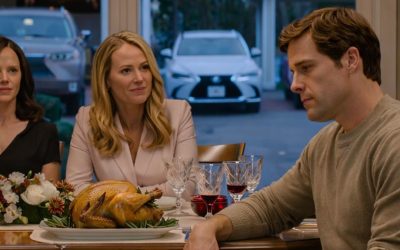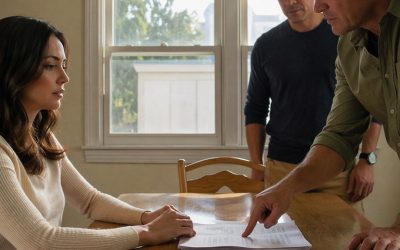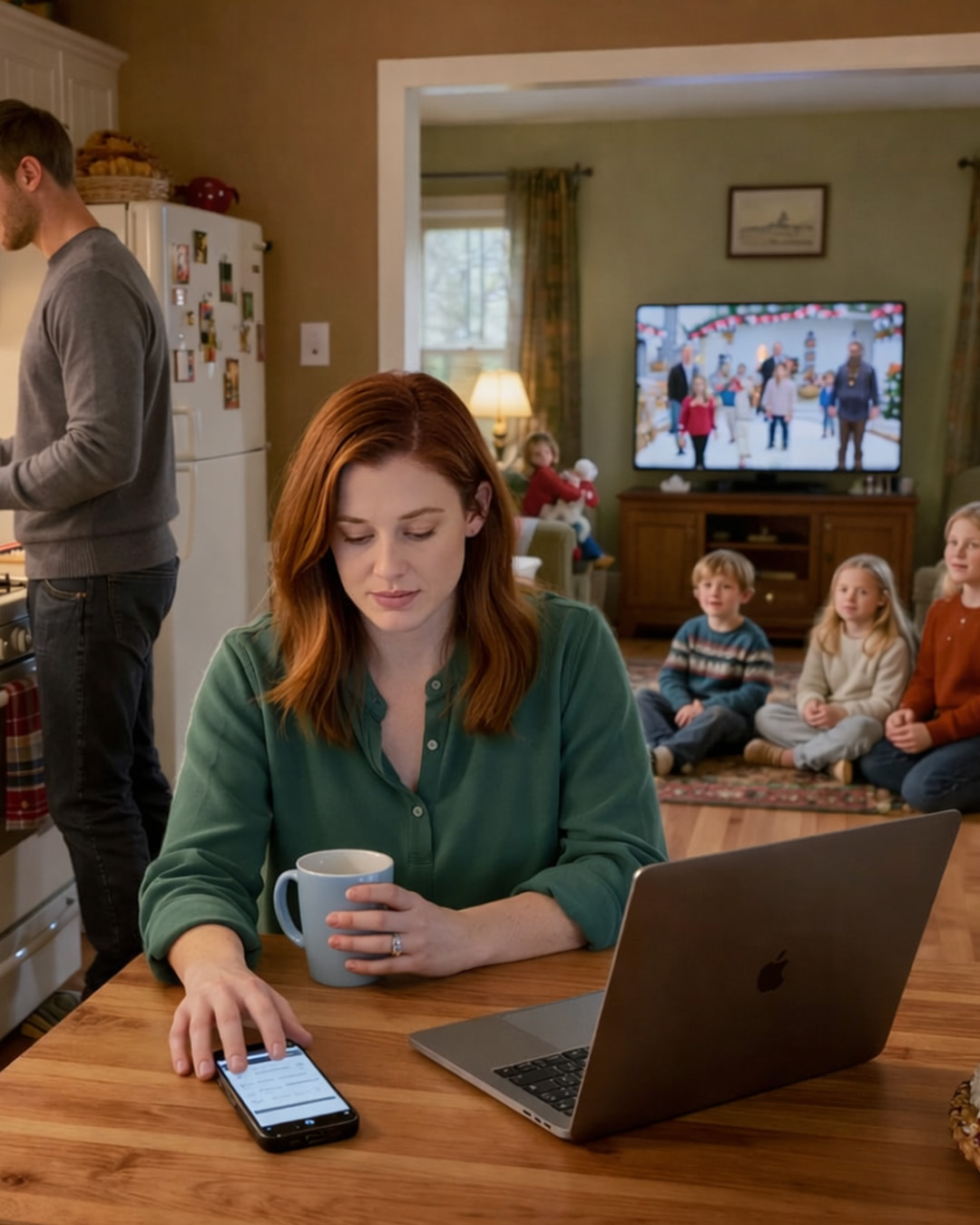
Dinner was fine. Pot roast, green beans, rolls from the bakery. Eleven of us around the table Mom had owned since 1994, the year Dad bought that house with a VA loan and a handshake. Mom said grace. She thanked God for family, for health, for the food. She did not mention the tablecloth I’d spread across the table an hour earlier while she watched without comment. After dinner, I washed dishes. Ashley dried one plate, then set it down and pressed a hand to her back.
“My back hurts.”
Mom called from the living room.
“Let her rest, honey. She’s been having a rough week.”
Ashley had been having a rough week since 2019.
By eight-thirty, the kids were fading. Owen’s eyes were doing that thing they do when he’s trying to stay awake, half closed, too proud to say he’s tired. Ellie was already curled on the couch with her rabbit, one shoe off. I found Mom in the hallway.
“Mom, should I set up the guest room for Owen and Ellie? I can put them on the floor in there with blankets, or…”
She gave me the smile. The one I’d seen my whole life and never had a name for until that moment. Warm on the surface. Closed underneath. A door painted to look like a door, bolted from the inside.
“Oh, honey. Ashley’s kids are already settled in there. You know how Mackenzie is if we move her. She won’t sleep at all.”
Her hand found my arm and squeezed.
“Your kids are troopers. They’ll think it’s an adventure.”
Then she opened the hallway closet and took out two sleeping bags. Dinosaur print. Nylon so thin you could almost see the floor through it. They smelled like the basement—damp, forgotten, the way things smell when nobody has checked on them in years. She tossed them toward the living-room floor. One landed near Owen’s feet. He looked at it and didn’t pick it up. He just stood there with his hands at his sides, watching my face. Six years old, and already reading the room better than anyone in it.
Ellie picked hers up and hugged it.
“Is this for me, Mommy?”
Ashley leaned against the guest-room doorframe, arms crossed, wearing that half-smile again.
“Should have booked a hotel.”
I counted. Coats on the hooks: five. None of them ours. Photos on the mantel: seven. I was in one of them, barely, in the background of Ashley’s birthday party holding a cake. Steps from where I stood to the front door: fourteen. The pie was still on the counter, untouched. The tablecloth was already hidden beneath the dirty dishes. I knelt down so I was eye level with Owen, then with Ellie.
“Pack your things, babies,” I whispered. “We’re going on a real adventure.”
Ryan didn’t ask a single question. He read my face and started moving. Suitcases off the banister. Ellie’s rabbit off the couch. Owen’s coat from the chair where I’d draped it because there hadn’t been room on the hooks. Four suitcases. One pie carrier. One gift bag, empty now. I buckled Ellie into her car seat. She was already half asleep, still holding the dinosaur sleeping bag. Ryan carried Owen, who had gone completely silent—the kind of silence six-year-olds get when they understand something they should never have to understand yet.
Mom appeared in the doorway, porch light behind her, arms at her sides.
“Lauren, don’t be dramatic. It’s just one night.”
I didn’t turn around.
“It was never just one night, Mom.”
It was 11:07 p.m. I know because I watch the clock. I count things. Streetlights out of the neighborhood: nine. Stop signs before the highway: two. Minutes before Maple Grove disappeared in the rearview mirror: four. My mother stood in the doorway watching our taillights until I turned the corner. She didn’t come after us. She never came after us.
Have you ever driven away from a place you spent your whole life trying to belong to? I have. And I’ll tell you something nobody warns you about. It doesn’t feel like freedom. Not yet. It feels like math. Cold, simple math. The kind you do in the dark at seventy miles an hour while your children sleep in the back seat, your husband drives in silence, and you sit there adding up every dollar, every dinner, every drive, every pie you baked from your dead father’s recipe, until you realize the total was never going to be enough. Because you were never the one they were counting.
The pie was still between my feet. In the rush to get the kids and the suitcases out, I’d forgotten the carrier on the porch until Ryan picked it up and set it on the passenger-side floor without a word. So there I was on Highway 52 South at eleven-something at night, the whole car smelling like brown butter and nutmeg. My father’s hands smelled like that on Thanksgiving mornings. Not always. Most days he smelled like motor oil and the spearmint gum he chewed after lunch. But on Thanksgiving mornings, he smelled like brown butter because he started the pie at six a.m. and refused help from anyone except me.
“The house doesn’t hold itself up, kid,” he used to say while I measured flour from the stepstool.
He wasn’t talking about the pie. He was talking about everything else—the furnace filter he changed every three months, the gutters he cleaned in October, the mortgage checks he wrote by hand because he didn’t trust auto-pay. He meant somebody had to do the work nobody saw. And if you were the one doing it, you shouldn’t expect a parade. He never got a parade. He got pancreatic cancer at fifty-three and died at fifty-seven. The last thing he said to me in the hospice room in Rochester was this:
“Take care of the house, Lauren.”
He didn’t mean the building. He meant the people in it.
I was twenty-five then. I’d been a dental hygienist for two years. I made fifty-eight thousand dollars a year and drove a Honda with a dent in the rear bumper from backing into a mailbox. Three weeks after the funeral, Mom called. She didn’t cry. That was the thing about my mother—she saved her crying for audiences. On the phone with me, she was all business wrapped in sweetness, like a bill inside a birthday card.